Businesses with large amounts of unstructured data will always struggle to simplify their operations and make informed decisions. Having well-defined, structured data, on the other hand, would encourage secure and consistent data processing without the need to look for the right data collection every time.
Without a doubt, data annotation is an unavoidable element of every organisation. Data annotation for ML is the only way to get the needed data from a pool of data that is already accessible. In reality, annotated and labelled data is critical for the success of Artificial Intelligence (AI) and Machine Learning (ML) implementations.
First, let’s start with a definition of data annotation.
One of the most critical phases of preparing data for a Machine Learning model is data annotation. When Supervised Learning models are put in the field, they simply learn to repeat their training data, therefore poor quality annotations result in poor model performance.
In simple terms, Annotating data in any format, such as text, photos, audio, or video, is known as data annotation. With the help of the correct tools and approaches, labelled data sets are required to detect repeating patterns in annotated data. When the machine algorithm has processed enough annotated data, it begins to detect similar patterns when given additional unannotated data.
Trending AI Articles:
2. How AI Will Power the Next Wave of Healthcare Innovation?
Various types of data annotation
Now that you know what data annotation is, let’s look at the types of data annotations available.
1. Text Annotations
A metadata tag is used to indicate up properties of a dataset during the annotation process. That data comprises tags that emphasize criteria such as keywords, phrases, or sentences in the case of text annotation. Text annotation can also entail marking different feelings in text, such as “angry” or “sarcastic,” to educate the computer on how to discern human meaning or emotion behind words in some applications.
2. Video Annotations
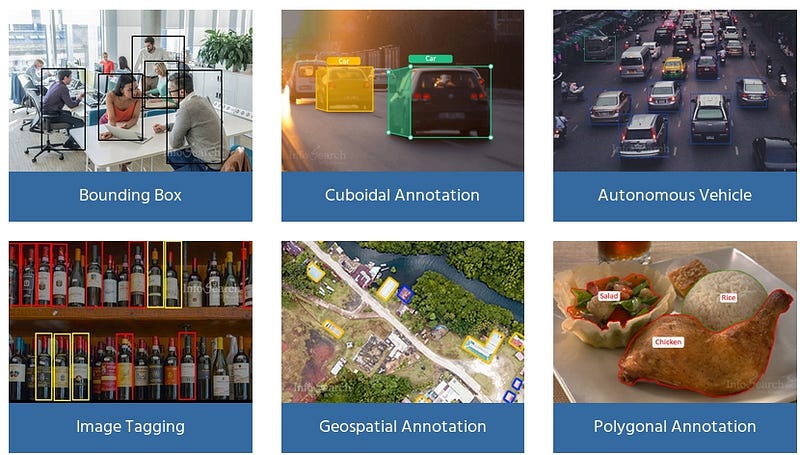
The technique of adding metadata to unlabeled video files in order to develop and train a machine learning system is known as video annotation. To annotate objects in each frame and execute the job, it comprises the use of bounding boxes, key points, and polygon annotation.
3. Image Annotations
The process of categorising photos in a dataset in order to train a machine learning model is known as an image annotation. As a result, picture annotation is utilised to indicate the aspects your system needs to recognise. Supervised Learning is the process of training an ML model given labelled data. It entails the use of AI systems to analyse pictures and is widely used in robotic vision, computer vision, facial recognition, and other areas.
4. Content Annotations
The activity of monitoring and applying a pre-determined set of rules and standards to user-generated contributions in order to assess whether the communication (in this case, a post) is permitted or not is known as content moderation. It entails successfully filtering user-generated material and demonstrating high-quality content.
Why to outsource annotation services
Annotation is a time-consuming and arduous task that necessitates a highly skilled and professional workspace in order to produce massive volumes of annotated data such as videos or images that can be used to train computers and make them viable for AI-based models.
This necessitates outsourcing to a top data labelling firm, such as Anolytics, which provides low-cost data labelling services. Anolytics is also a specialised and best polygon annotation service firm in the market. When you outsource polygon annotation service, you’re starting a chain of events that, if done right, may result in huge advantages in the form of dependable AI engines.
Also Read : Why Human Annotated Datasets is Important for Machine Learning?
EndNote
Data annotation is a cutting-edge data analysis tool that may assist businesses in taking their operations to new heights through strategic planning and updated procedures. Data annotation involves everything from data collection to categorisation to the difficult task of data processing. Businesses have access to relevant information and can make better decisions. Many firms have profited from continued data support for AI by closing more transactions and saving a significant amount of time while remaining ahead of their competitors.
Don’t forget to give us your 👏 !








 Data Annotation Services for Generative AI | Anolytics
Leave a comment